
When to Hold a Compounder Past Its Margin of Safety
You buy a good business cheap. The market wakes up, the discount closes, and the classic value rule fires: thesis complete, sell. On a mediocre business that is correct. On a genuine franchise it is the single most expensive mistake in value investing — you hand the compounding decade to someone else at the exact moment your conviction should be rising.
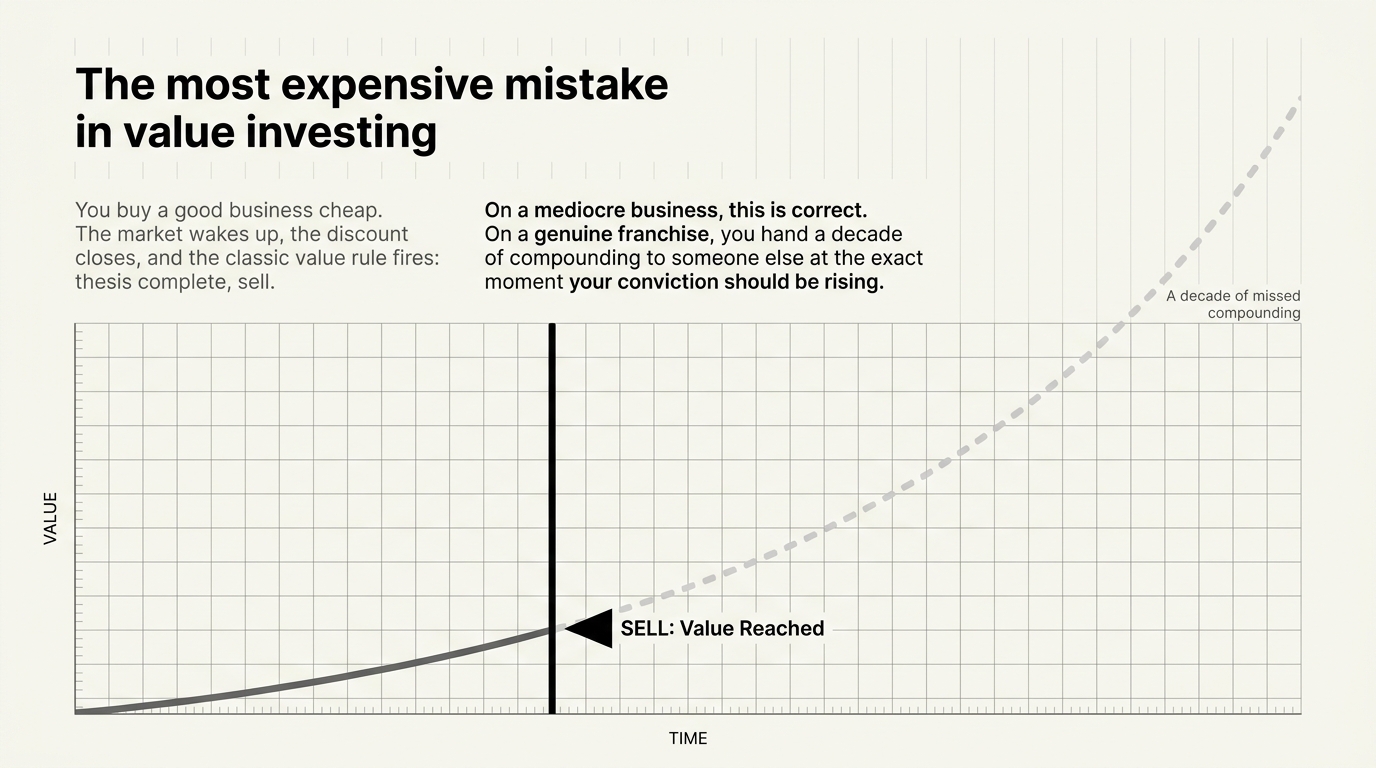
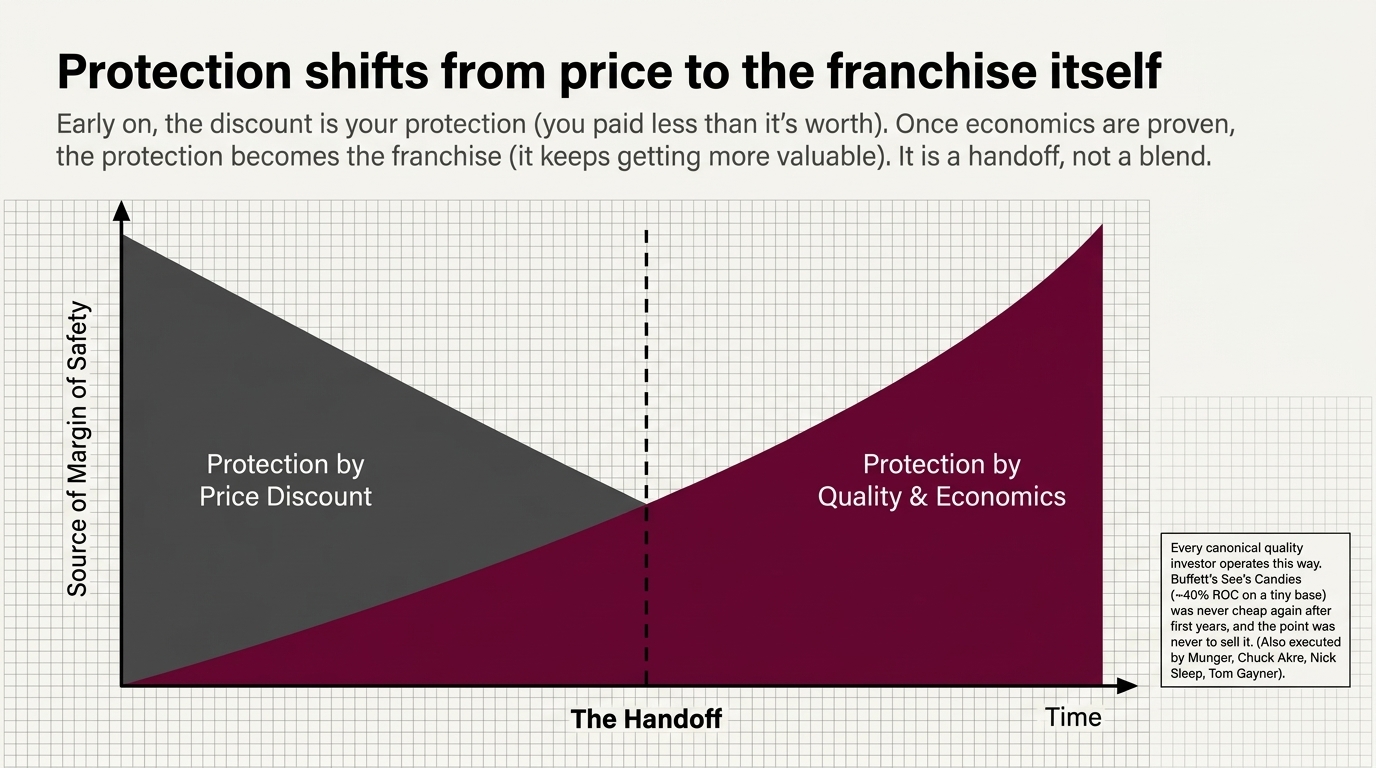
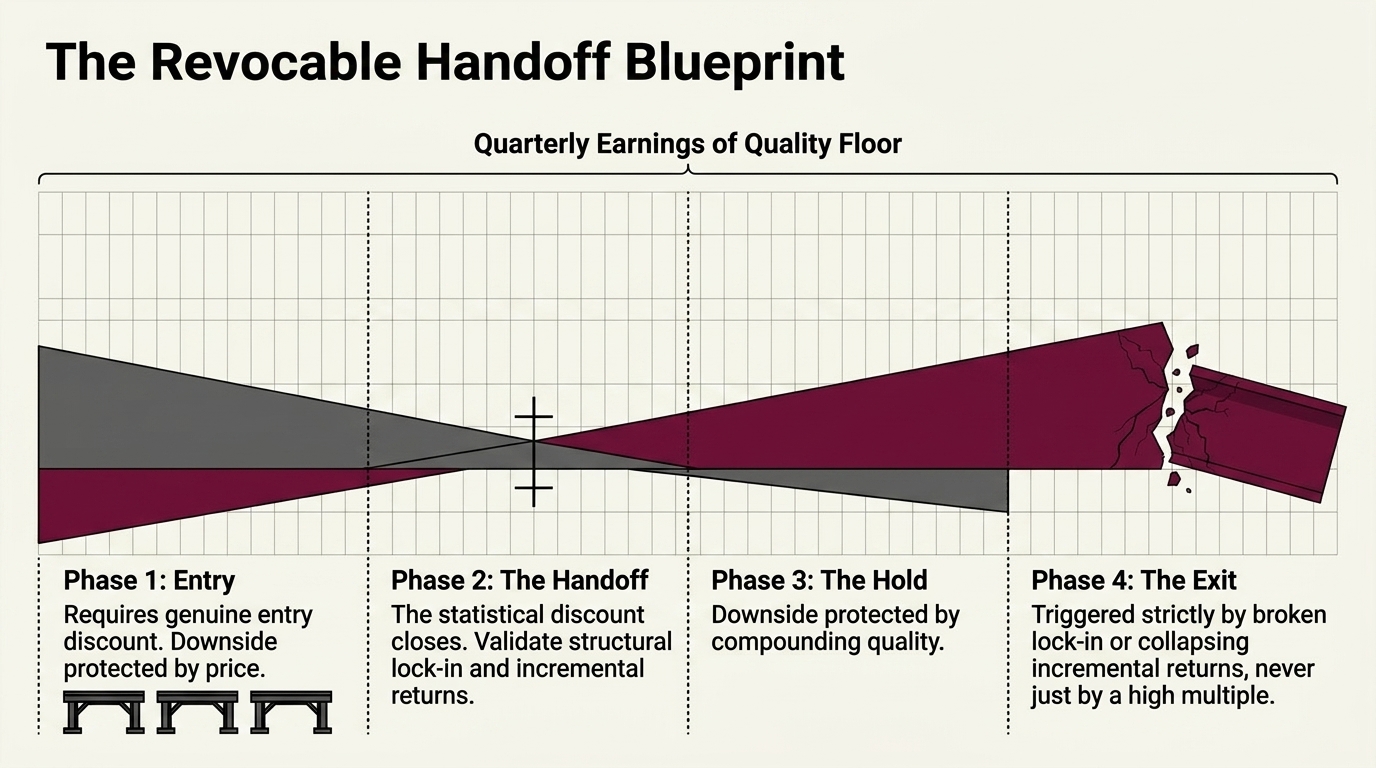
The resolution is that the margin of safety hands off — from price to quality. Early on, the discount is your protection: you are safe because you paid less than the business is worth. Once the business proves the durability of its economics, the protection becomes the franchise itself: you are safe because the thing keeps getting more valuable, cheap or not. It is a handoff, not a blend. Price stops being the reason you hold; quality becomes the reason.
This is not a theory about how investing ought to work. Every canonical quality investor operates this way — Buffett and Munger, Chuck Akre, Nick Sleep and Qais Zakaria, Tom Gayner. None of them sold their great compounders when the statistical cheapness disappeared, and holding through margin-of-safety erosion is the behavior that produced the record. See's Candies was never cheap again after the first few years — roughly a 40% return on capital on a tiny capital base — and the point was never to sell it.
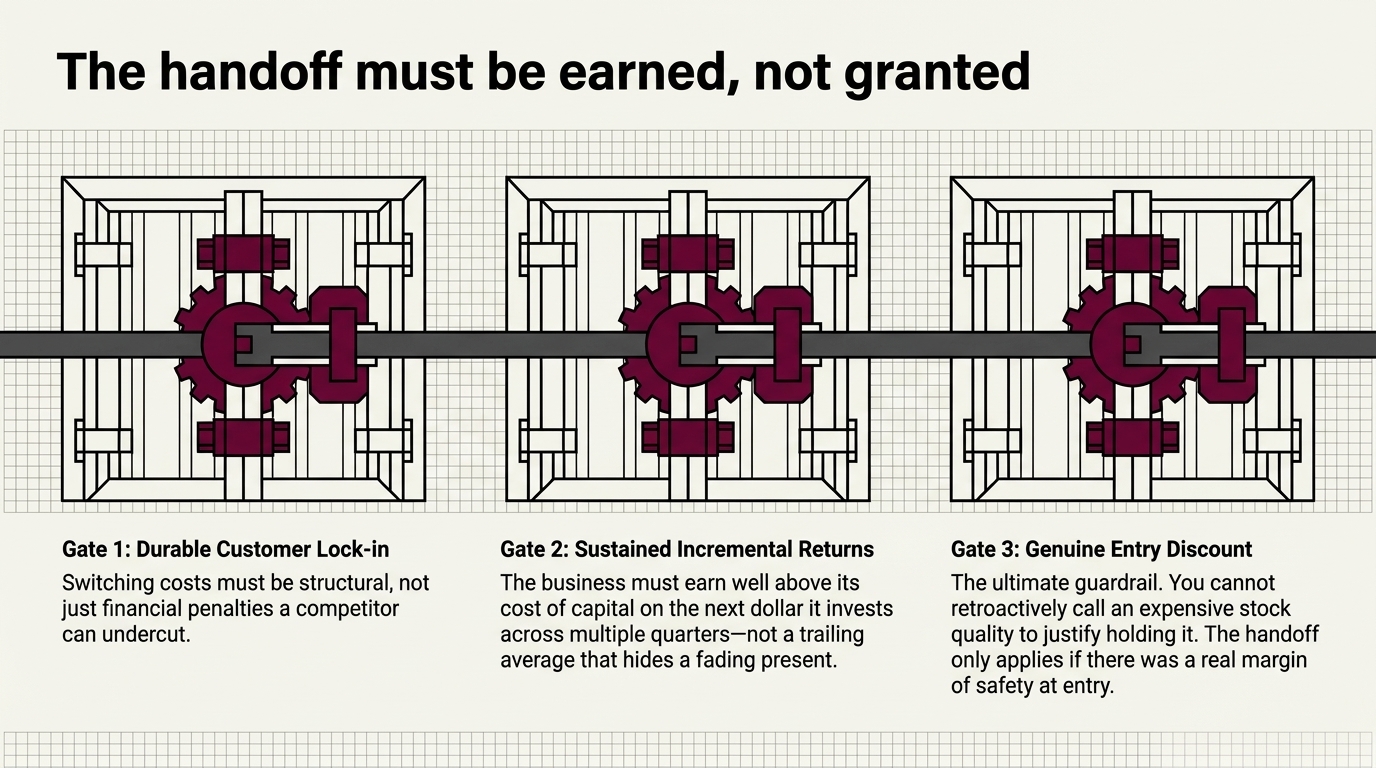
The handoff is only legitimate when the business has proven it is a franchise and not merely a stock that went up. Three markers, and they only count together. Durable customer lock-in, meaning switching costs that are structural — contractual, procedural, data, or physical — rather than financial penalties a competitor can simply undercut. High returns on incremental capital, sustained: the business earns well above its cost of capital on the next dollar it invests, held across multiple quarters, because a great past average can hide a fading present. And a genuine discount at entry. That last one is the guardrail that stops the whole idea from becoming an excuse — you cannot retroactively call an expensive stock "quality" to justify holding it.
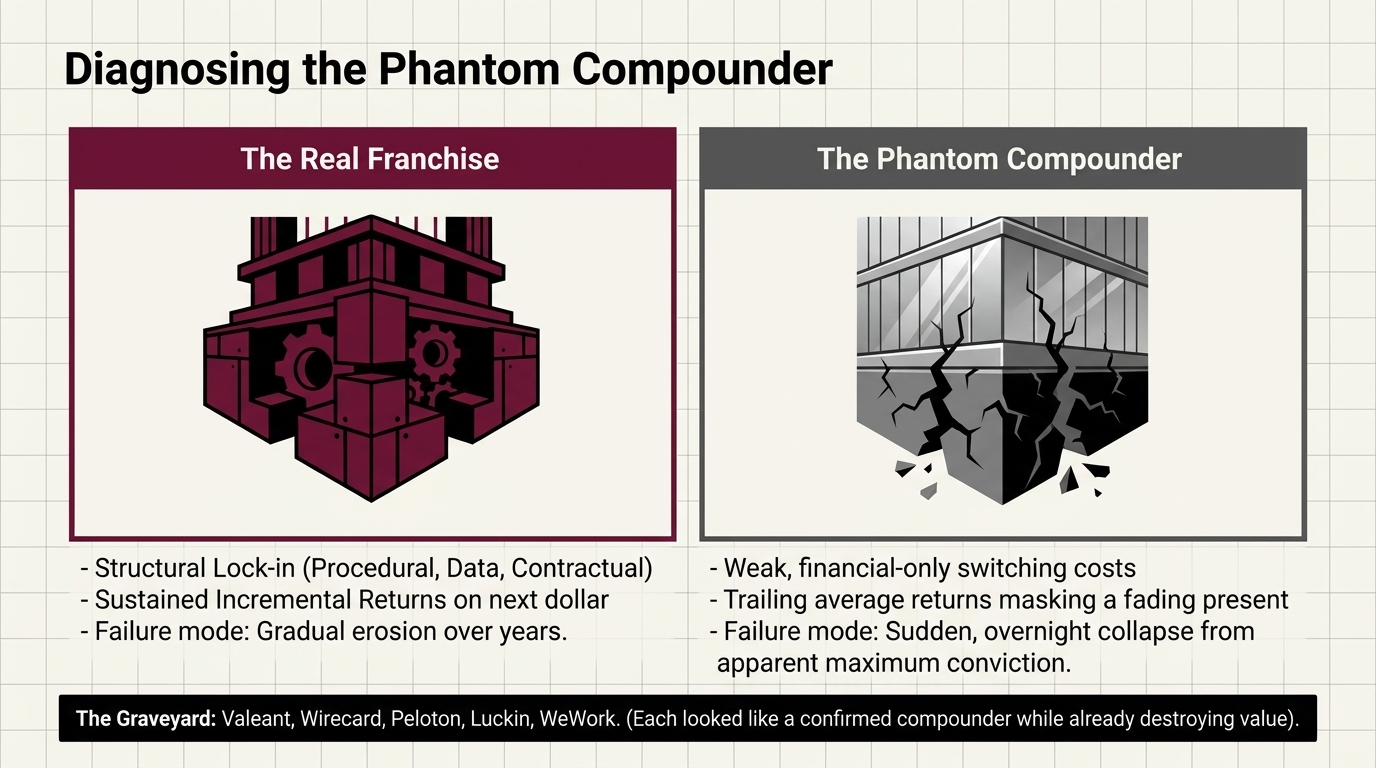
The dangerous misreading is "great company, hold through anything." The reason this is hard — and the reason it is worth getting right — is that a phantom compounder looks identical to a real one until it doesn't. A full stack of weak, financial-only switching costs presents as a 100x-caliber franchise and then vaporizes to a regulatory change (open banking, number portability) or a zero-fee challenger. The failure isn't gradual erosion. It is sudden collapse from apparent maximum conviction, and the graveyard is specific: Valeant, Wirecard, Peloton, Luckin, WeWork — each looked like a confirmed compounder while it was already destroying value.
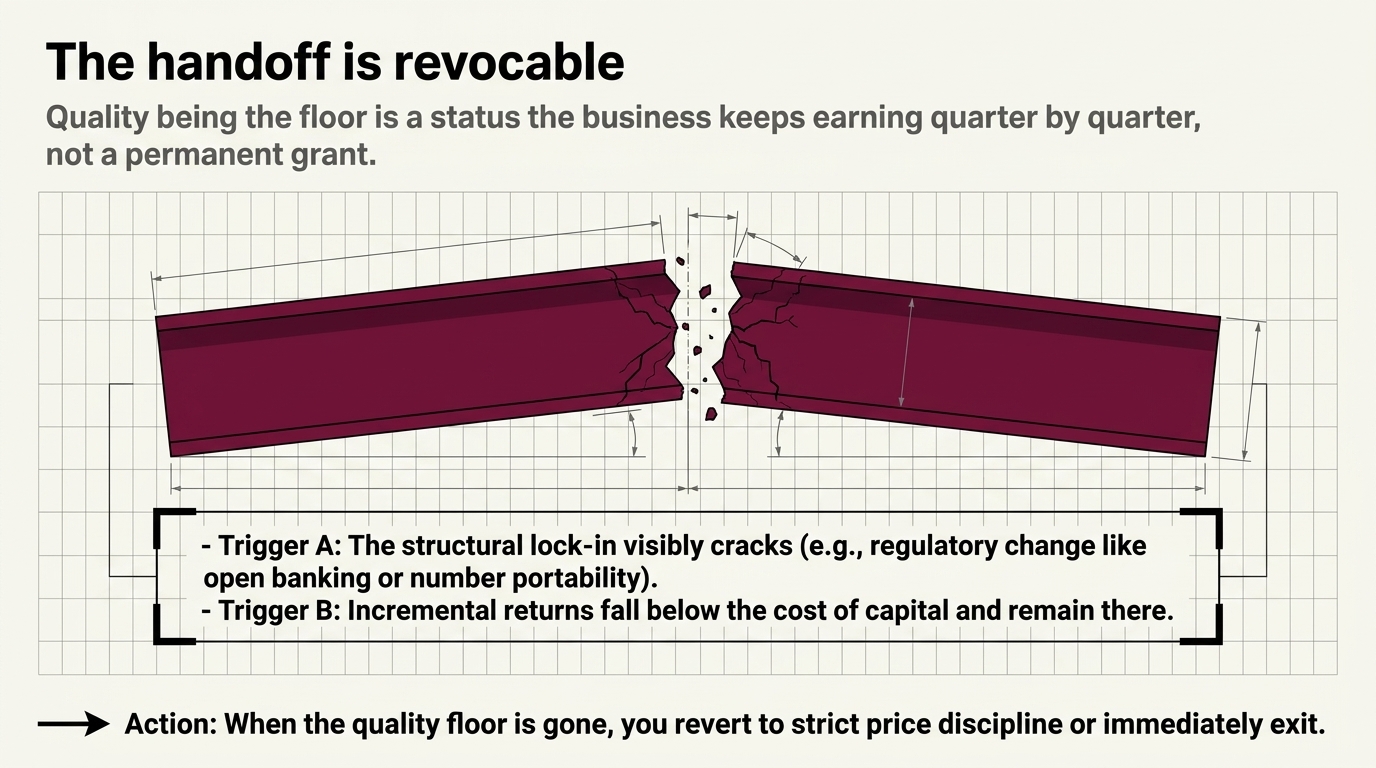
Quality being the floor is a status the business keeps earning, quarter by quarter. It is not a permanent grant.
So the handoff is revocable, and the revocation triggers are what keep it honest. If the lock-in visibly cracks, or if incremental returns fall below the cost of capital and stay there, the quality floor is gone — and you revert to price discipline or you exit. Note what is not on that list: a high multiple. The exit is triggered by the business breaking, never by the stock being expensive, which is the whole point of the handoff.
The insight cuts both ways, and that is what makes it usable. It tells you to hold the real franchise past its cheapness — and it tells you the exact conditions under which "it's a great compounder" is the story that is about to cost you everything.
Sources
Buffett and Munger (Berkshire letters; Cunningham, The Essays of Warren Buffett); Chuck Akre (the three-legged stool); Nick Sleep & Qais Zakaria (Nomad Investment Partnership letters); Tom Gayner (Markel); Greenwald, Value Investing (franchise value and earnings power); Mauboussin (returns on incremental capital, competitive advantage period); Zook, The Founder's Mentality; Shapiro & Varian, Information Rules (switching-cost types); public financials of the named cases — Valeant, Wirecard, Peloton, Luckin, WeWork.
Not AI-generated signals.
Get the next piece by email.
One email when new research publishes. No spam, no tipsheet.
One email when a new piece publishes. No spam.
Published 26 Jul 2026 and not revised since. Informational only — not investment advice or a recommendation. Corrections: research@863labs.com.