
Early Warning Signs a Competitive Moat Is Collapsing
The standard picture of competitive decline is a moat eroding slowly while returns drift back toward the cost of capital. It is wrong in exactly the cases where being wrong costs the most. When a real franchise breaks, it does not fade. It cascades — and the accounting stays green while it happens.
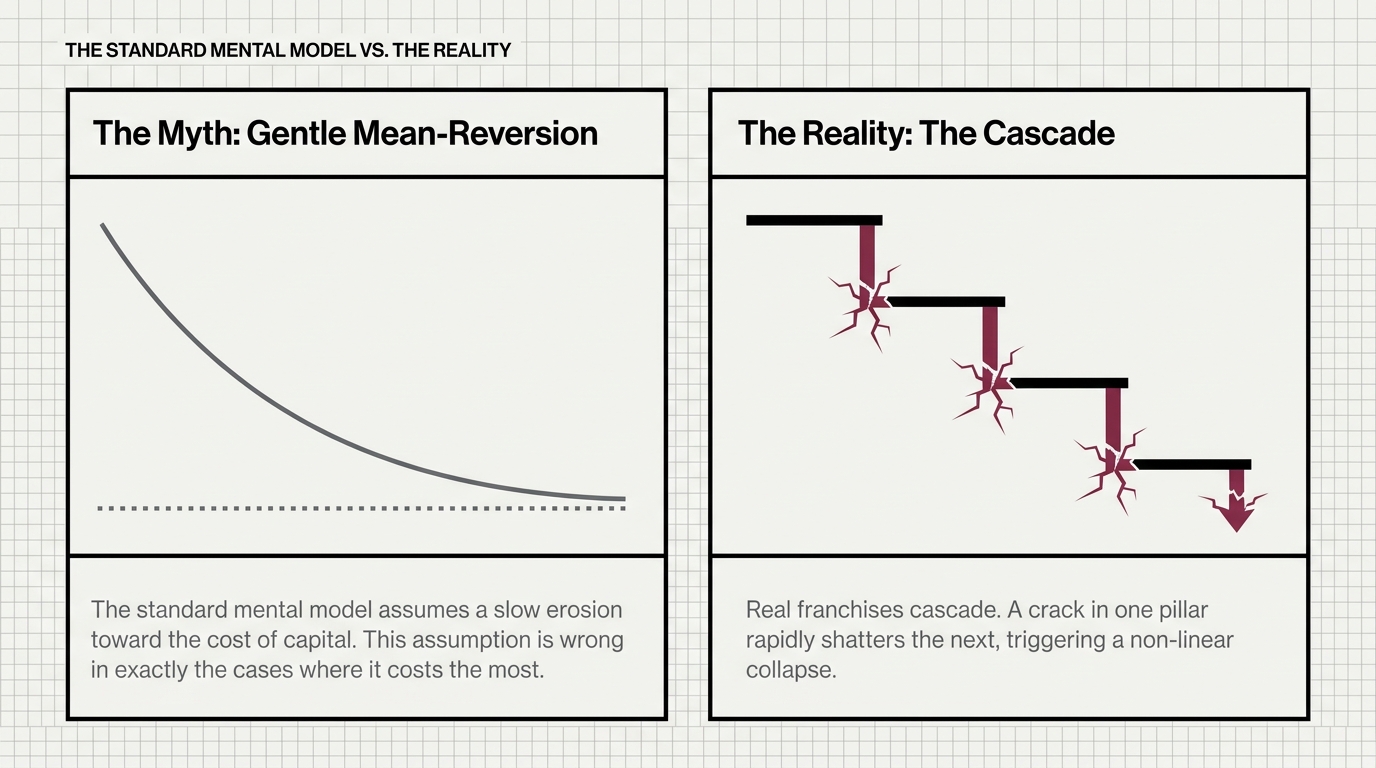
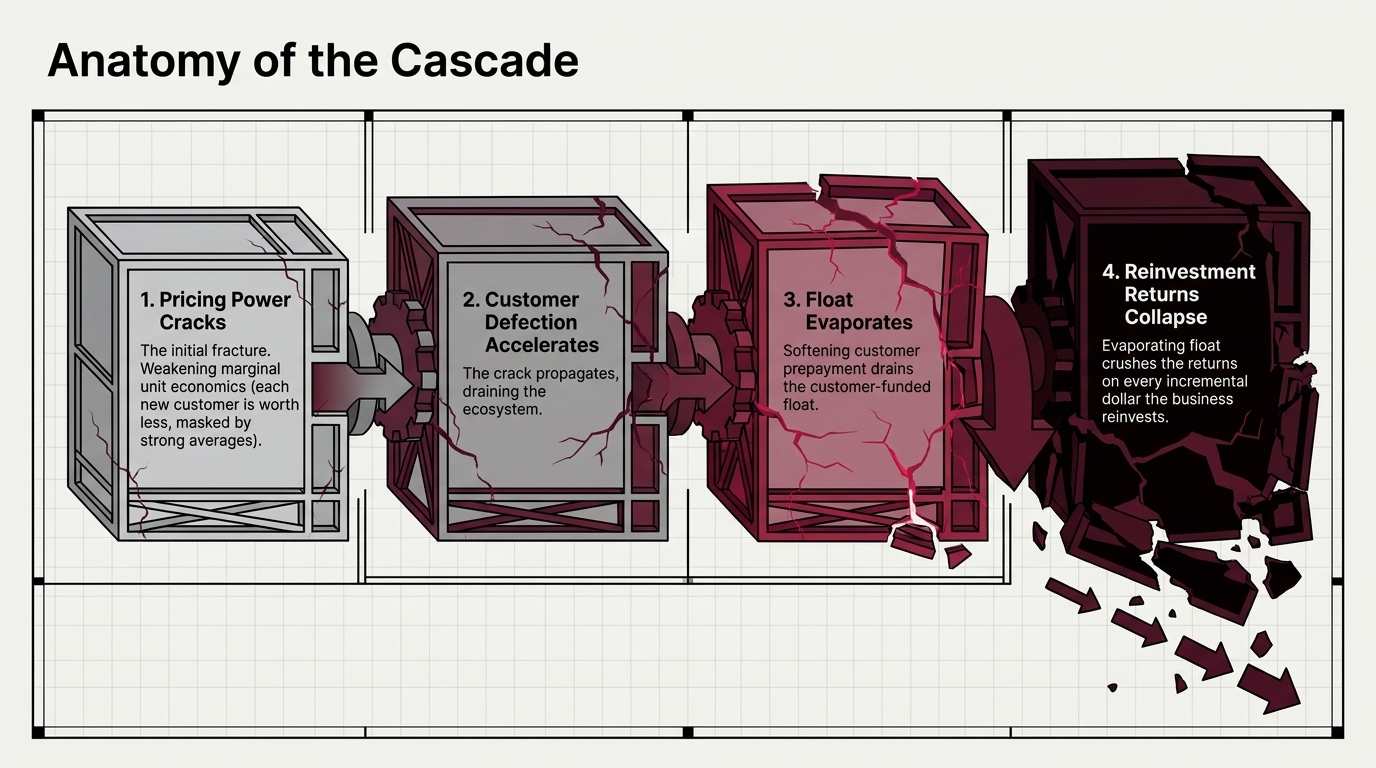
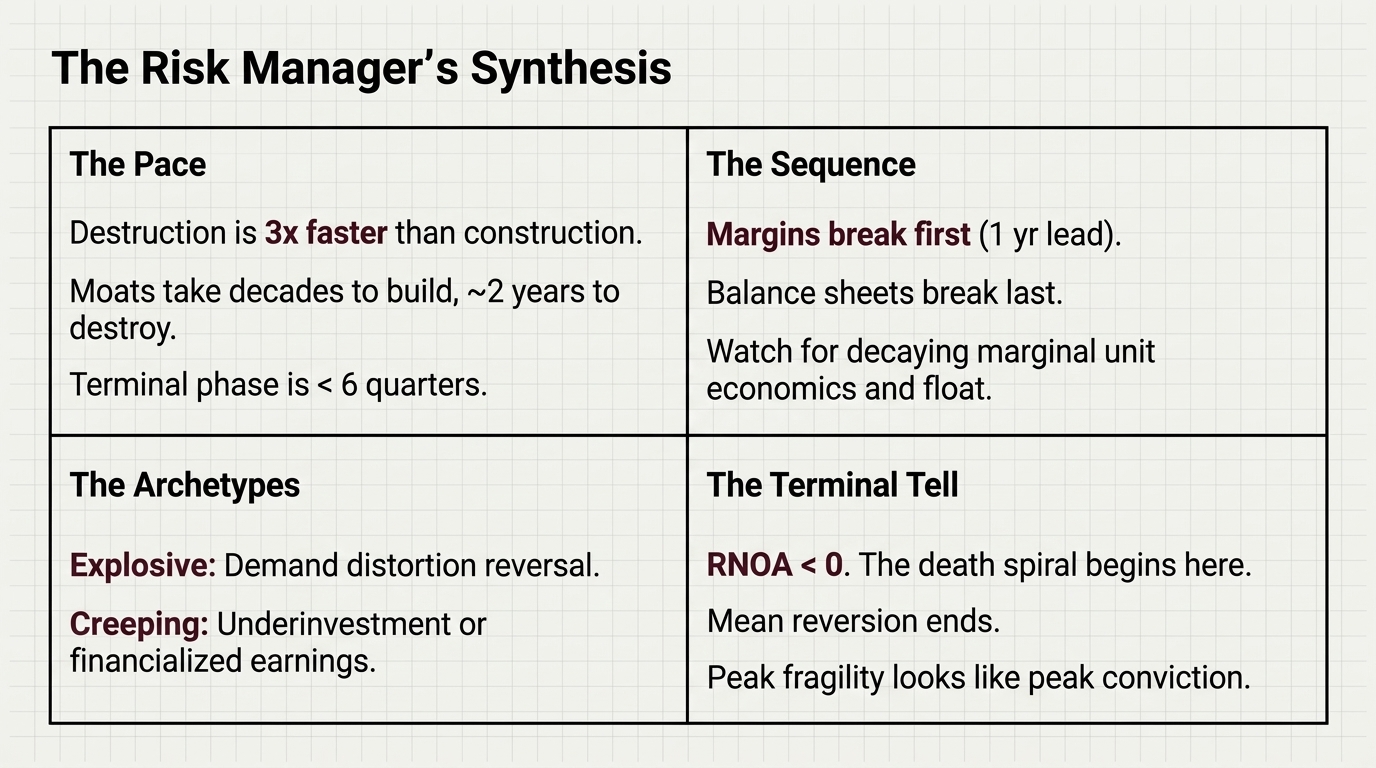
The destruction is a cascade, not a fade. A crack in pricing power propagates into customer defection; defection drains the customer-funded float; the evaporating float collapses the return on every incremental dollar the business reinvests. Each stage feeds the next, which is why the unraveling runs at several times the pace of ordinary competitive decay. Across the documented graveyard — Nokia, BlackBerry, Kodak, Sears, GE, IBM, Xerox — moats took roughly three times longer to build than to destroy: decades of accumulation, then a collapse that typically completes in about two years, with the acute phase inside six quarters. Terminal damage runs from two-thirds to near-total loss. Switching-cost moats collapse fastest; scale moats hold out longest and suffer the worst absolute destruction when they finally go.
The order is the product. Pricing power cracks first — it led in six of seven documented collapses, showing up as a sustained, accelerating gross-margin slide roughly a year before the damage reaches operating leverage and years before it reaches the balance sheet. The early-warning set is stable in its membership even when the firing order varies: management hubris and deteriorating capital allocation, weakening marginal unit economics (each new customer worth less than the last, masked by strong averages), and softening customer prepayment. Failures that start inside the company crack at the management-behavior end first; failures imposed from outside crack at the customer and pricing end. Either way the accounting laggards stay green long after the leaders have turned.
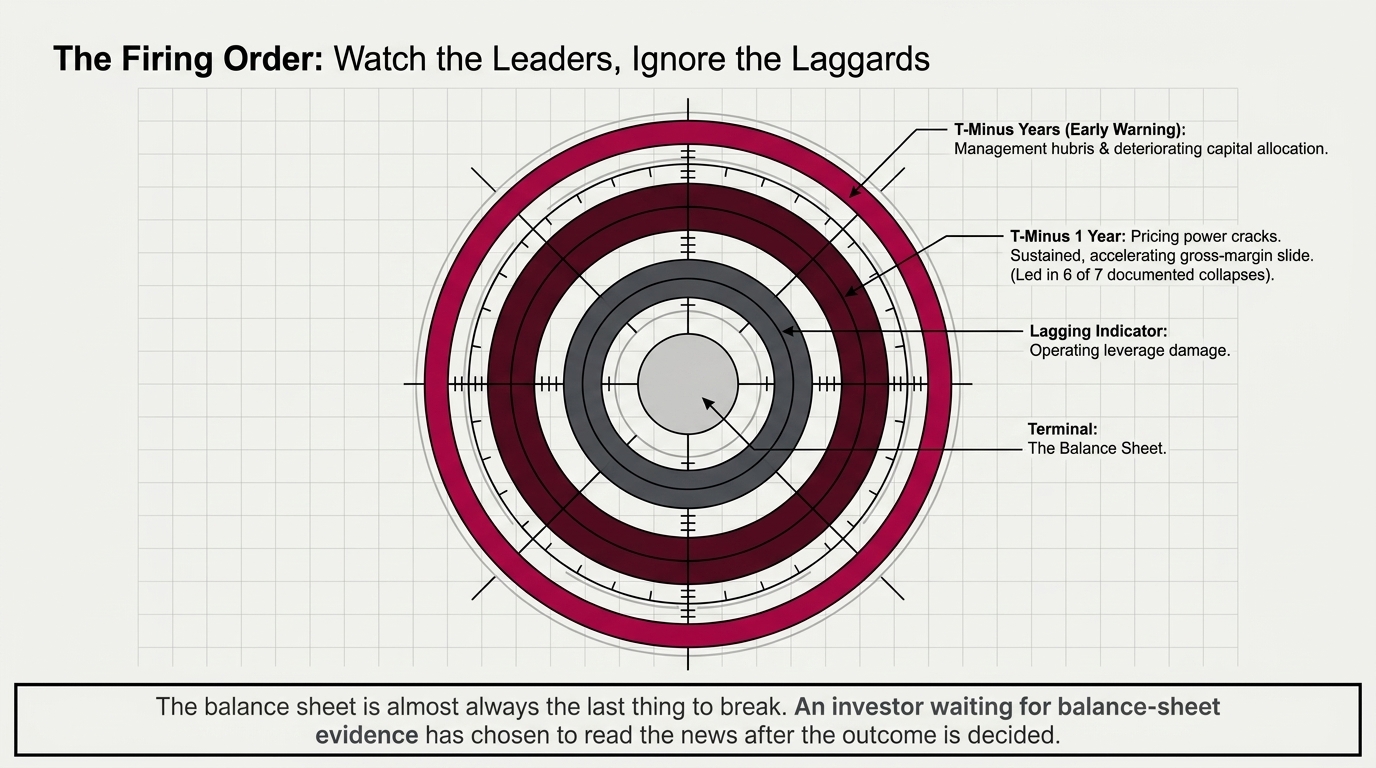
The balance sheet is almost always the last thing to break. An investor waiting for balance-sheet evidence has chosen to receive the news after the outcome is decided.
Two speeds, and they demand different vigilance. Explosive collapses ride a demand distortion — pull-forward, subsidized adoption, a narrative-fueled expansion — and give almost no lead time once the distortion reverses: Peloton, MoviePass, Zynga, Blue Apron, GE. Creeping collapses are engineered by underinvestment or financialized earnings and give years of warning to anyone reading the sequence: Valeant, Wirecard, Zillow, Kraft Heinz, Carvana. The same diagnostic works on both; only the clock changes.
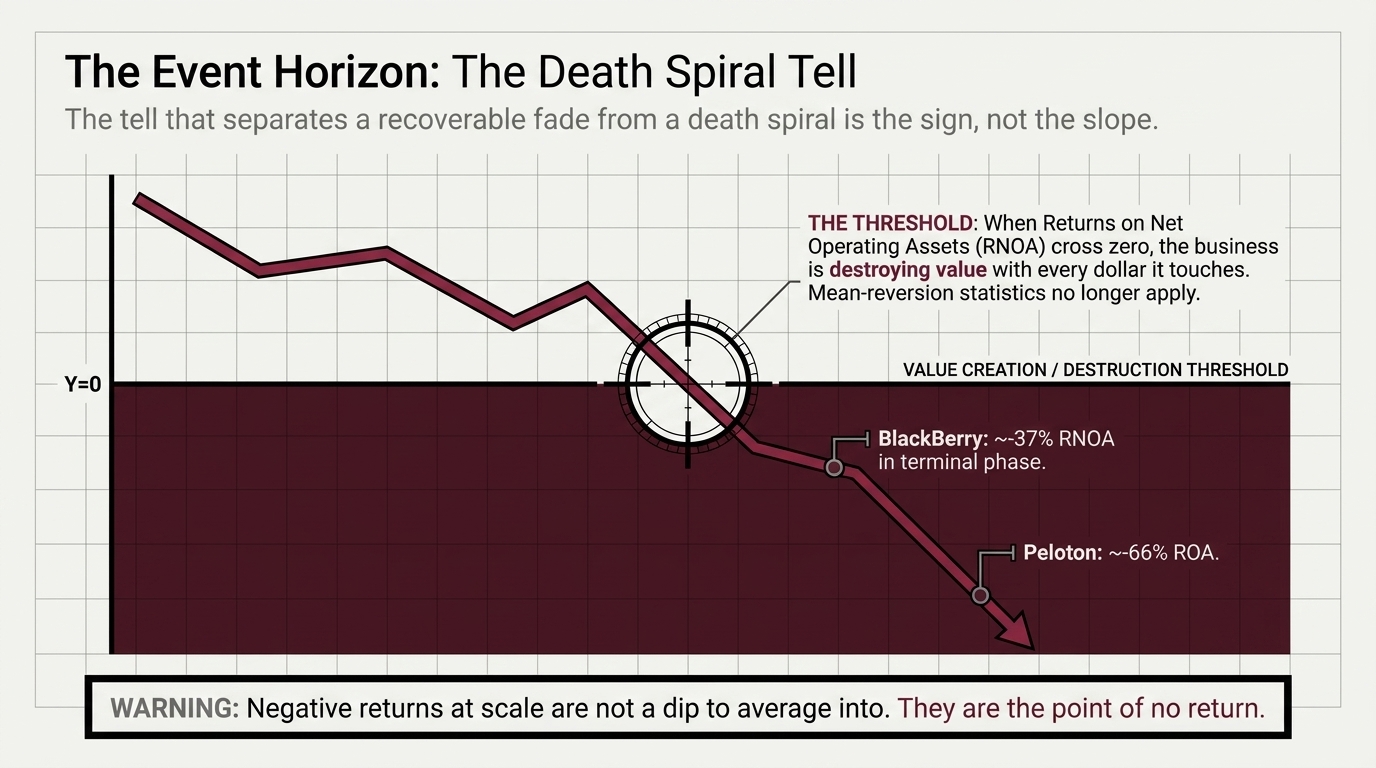
The tell that separates a recoverable fade from a death spiral is the sign, not the slope. When returns on net operating assets cross zero, the business is no longer fading toward mediocrity — it is destroying value with every dollar it touches, and the mean-reversion statistics that govern ordinary fade stop applying. BlackBerry ran roughly −37% on net operating assets in its terminal phase; Peloton hit roughly −66% on assets. Negative returns at scale are not a dip to average into.
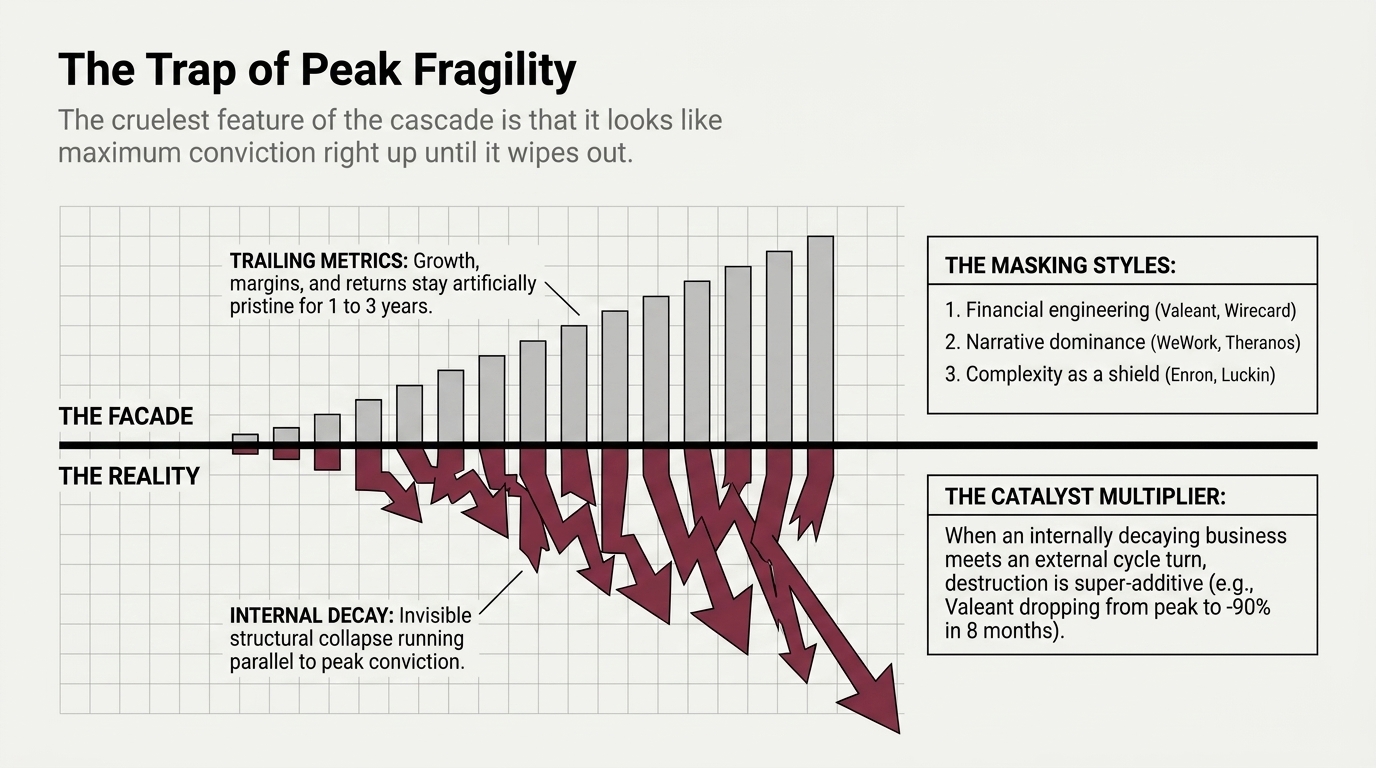
The cruelest feature is that it looks like maximum conviction right up until it wipes out. In the flagship failures every trailing metric was green — growth, margins, returns — while internal decay ran invisibly for one to three years, followed by a visible wipeout in two or three quarters. The masking has recognizable styles: financial engineering (Valeant, Wirecard), narrative dominance (WeWork, Theranos), complexity as a shield (Enron, Luckin). And when an internally decaying business meets an external cycle turn, the destruction is super-additive — Valeant went from peak to −90% in about eight months.
A boundary worth stating plainly: clean-audit fraud and overnight regulatory action are not detectable by financial-statement analysis. No amount of sequence-reading catches a Wirecard from the filings alone. The defense against that residual is position sizing, never detection confidence.
Sources
Helmer, 7 Powers (moat taxonomy and destruction dynamics); Greenwald, Competition Demystified (competitive-advantage erosion); Shapiro & Varian, Information Rules (lock-in and network tipping); Penman, Financial Statement Analysis and Security Valuation (fade rates, RNOA); Farrell & Klemperer (switching-cost economics); Dorsey, The Little Book That Builds Wealth; McKinsey (moat persistence and shuffle rates); Morningstar moat-rating reassessments; public financials of the named cases — BlackBerry, Nokia, Kodak, Sears, GE, IBM, Xerox, Peloton, Valeant, Wirecard, WeWork, Theranos, Enron, Luckin, Zillow, Kraft Heinz, Carvana, MoviePass, Zynga, Blue Apron.
Not AI-generated signals.
Get the next piece by email.
One email when new research publishes. No spam, no tipsheet.
One email when a new piece publishes. No spam.
Published 26 Jul 2026 and not revised since. Informational only — not investment advice or a recommendation. Corrections: research@863labs.com.