
Strategy Capacity: Why Concentrated Alpha Decays as Assets Grow
The strategy that beats the market at $50M cannot exist at $5B. Not because the manager got worse, and not because the edge was imaginary — but because the edge was denominated in dollars, and there were only ever so many of them.
Concentrated deep-value alpha has a specific physical source: entry discounts in small, illiquid names, usually during forced selling. Those discounts are finite in dollar terms — there is only so much mispriced stock available at the mispriced price. Your own buying is market impact, and past a certain size every incremental dollar you deploy pushes your entry toward fair value. You don't lose the edge. You pay yourself out of it.
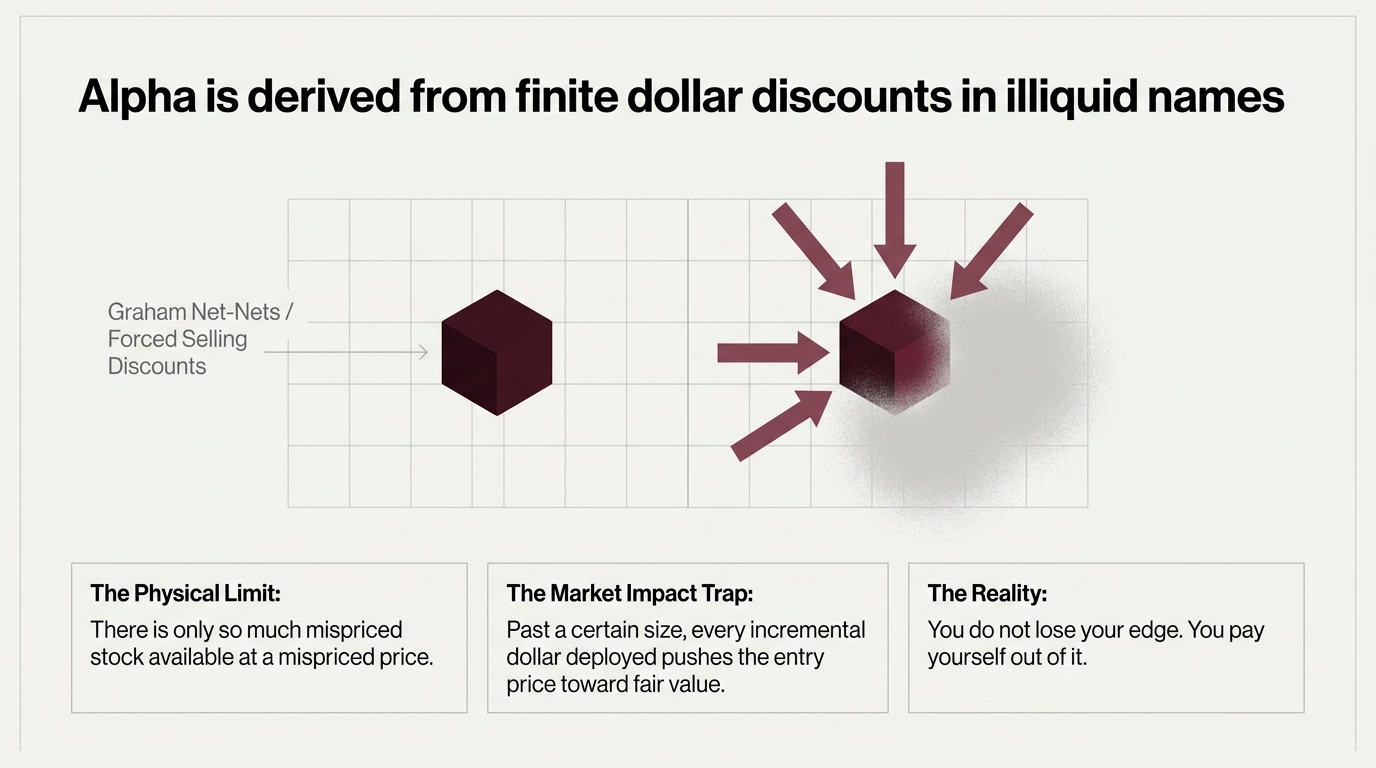
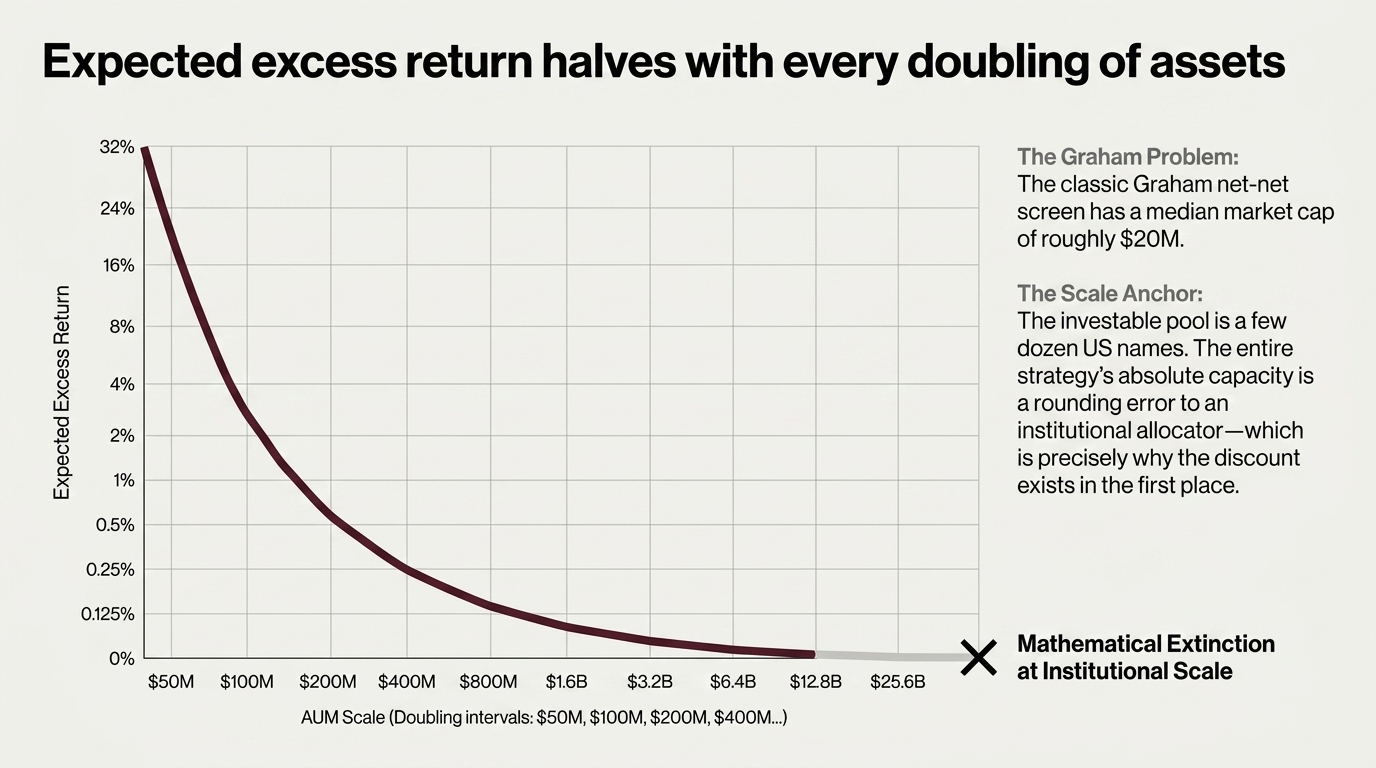
Capacity is therefore a property of the strategy, not a reflection of the manager — and the decay isn't linear. Past the ceiling, expected excess return roughly halves with each doubling of assets, which is mathematical extinction at institutional scale. Buffett has said it plainly for decades: size is an anchor, and on a million dollars he could compound at rates simply unavailable to Berkshire. The most extreme illustration is the classic Graham net-net screen — median market cap around $20M, an investable pool of a few dozen US names. The entire strategy's capacity is a rounding error to an institution, which is precisely why the discount persists.
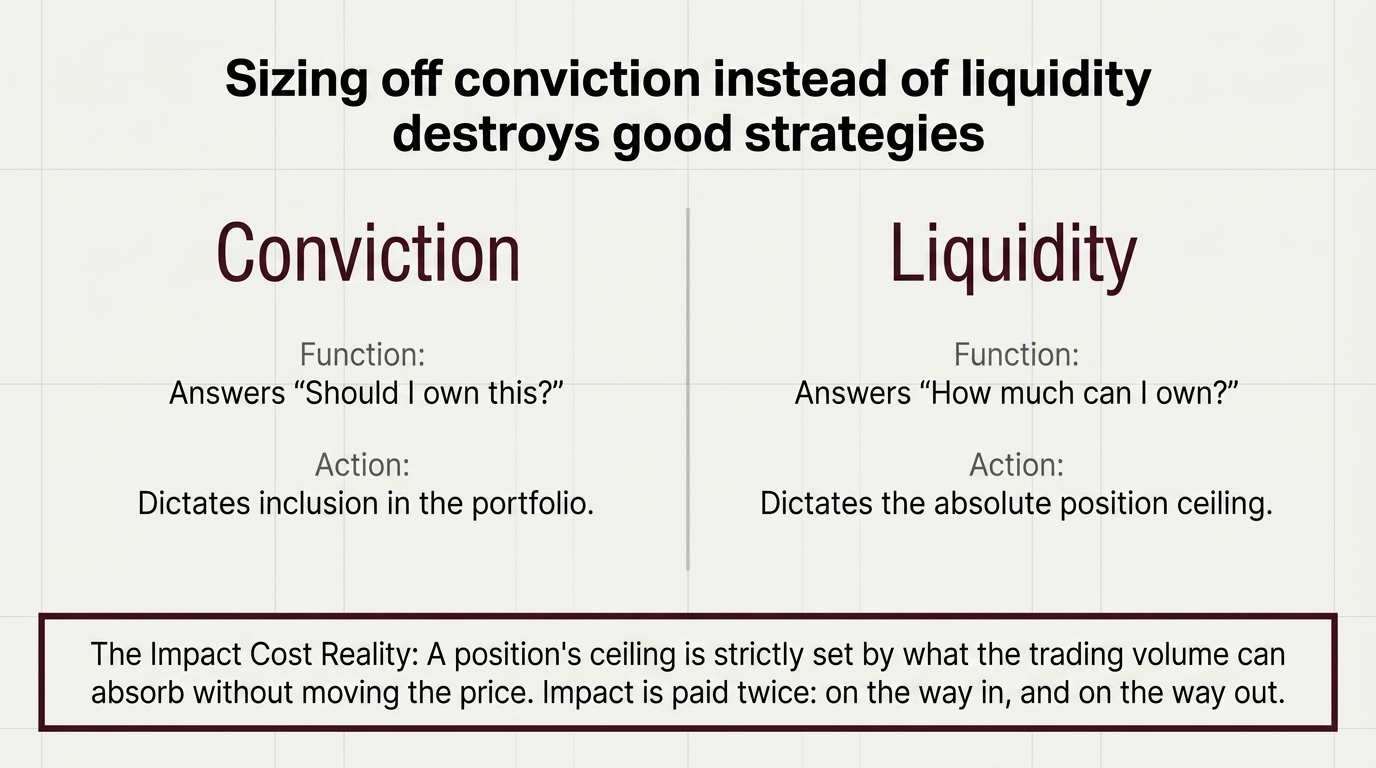
The discipline that falls out of this is to size to liquidity, not to conviction. Conviction answers should I own this? Liquidity answers how much can I own? They are different questions, and sizing off the wrong one is how good analysts break good strategies. A position's ceiling is set by what the name's trading volume can absorb without moving the price — on the way in and on the way out, because impact is paid twice.
Two ceilings operate together: a per-position cap, set by the impact cost of entering and exiting one illiquid name, and an aggregate cap, reached when the whole book can no longer redeploy at full discount. One subtlety earns its own sentence — the cap binds on new deployment, not on appreciation. A position that grows past your size limit by going up is not a problem; that is the strategy working. Forcing new dollars into it is.
Capacity limits are routing instructions, not quality compromises.
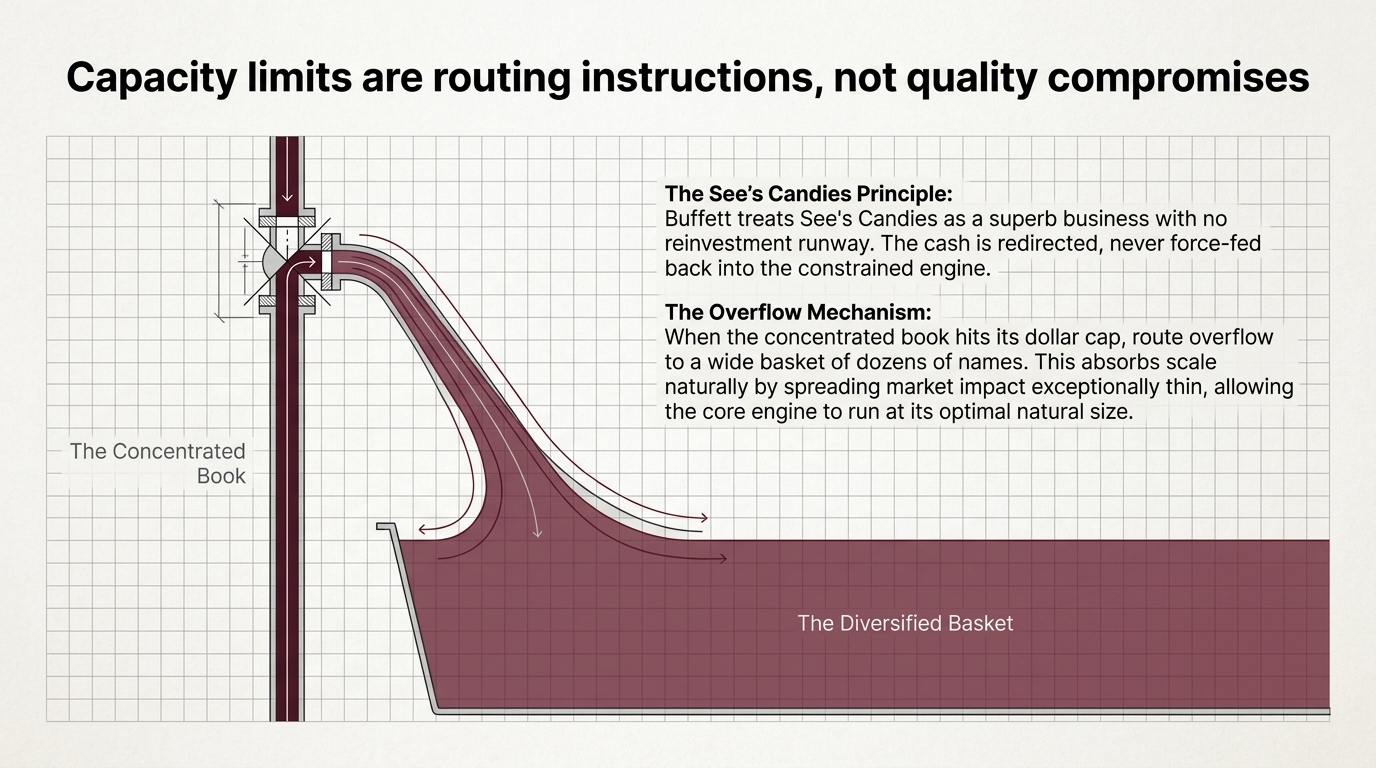
When capital can't deploy at full discount, the answer is neither diluting standards nor force-feeding the concentrated book. Route the overflow to a wide, diversified basket — dozens of names, no concentration requirement — which absorbs scale precisely because it spreads impact thin. Success then never forces strategy drift: the concentrated engine keeps running at its natural size and excess capital earns a diversified return instead of degrading the alpha source. Buffett's See's Candies is the same principle one level down — a superb business with no reinvestment runway, so the cash gets redirected rather than forced back in.
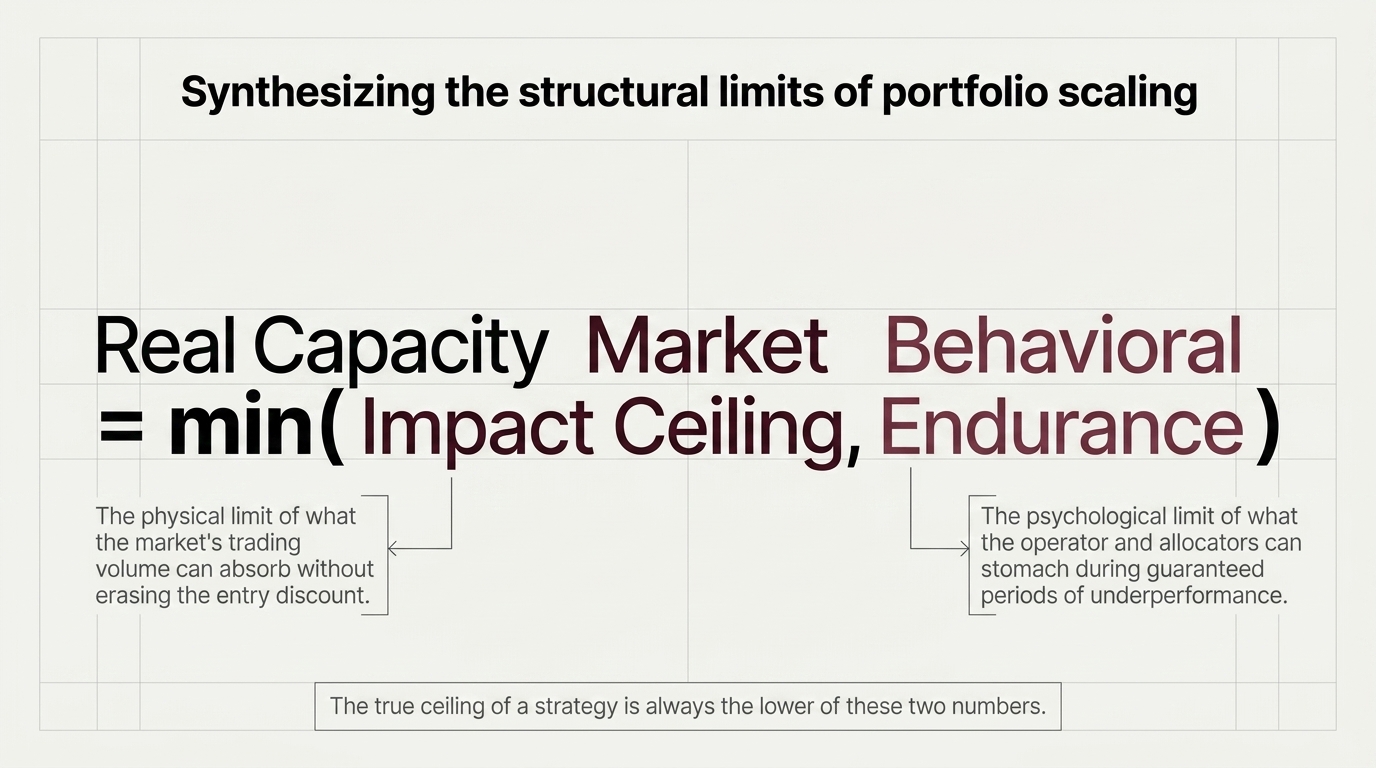
Market impact is only one of the two ceilings. The other is behavioral. DALBAR's work shows the vast majority of investors abandon strategies within a decade, overwhelmingly after stretches of underperformance against the index — which concentrated strategies guarantee. Cremers and Pareek found high-active-share managers outperform only when they hold patiently; the impatient ones give it back. Real capacity is the lower of two numbers: what the market can absorb, and what the operator can hold through tracking-error pain.
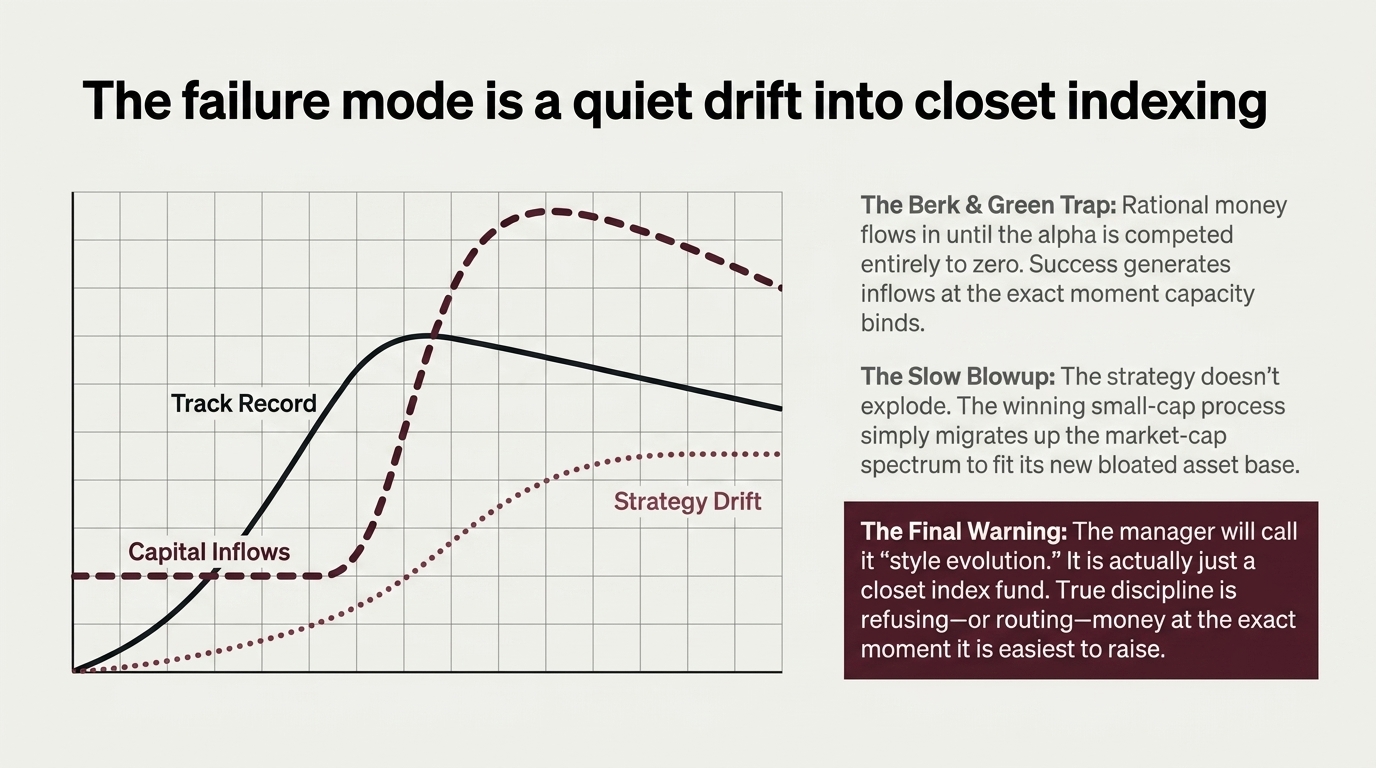
The trap this exists to prevent is the slow one. Success generates inflows at exactly the moment capacity binds — Berk and Green formalized it: rational money flows in until alpha is competed to zero. The track record becomes most marketable precisely when it becomes unrepeatable. The failure mode isn't a blowup. The winning small-cap process quietly migrates up the market-cap spectrum to fit its new asset base, turns into a closet index fund, and the manager calls it style evolution. The discipline is refusing money, or routing it, at the moment refusing money is hardest.
Sources
Buffett/Berkshire letters and interviews (size as an anchor; See's Candies economics); Berk & Green, "Mutual Fund Flows and Performance in Rational Markets" (2004); Cremers & Pareek (active share and patient capital); DALBAR QAIB (the investor behavior gap); Graham, Security Analysis (the net-current-asset framework and its capacity limits).
Not AI-generated signals.
Get the next piece by email.
One email when new research publishes. No spam, no tipsheet.
One email when a new piece publishes. No spam.
Published 26 Jul 2026 and not revised since. Informational only — not investment advice or a recommendation. Corrections: research@863labs.com.